Cost-effective and customizable Guanfacine 29110-47-2 in stock
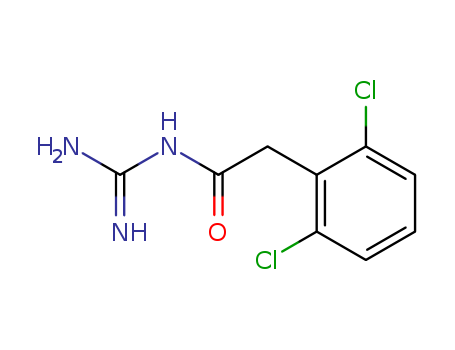
- Molecular Formula:C9H9 Cl2 N3 O
- Molecular Weight:246.096
- Vapor Pressure:2E-07mmHg at 25°C
- Melting Point:227-230?C
- Boiling Point:424.9°C at 760 mmHg
- PKA:11.92±0.46(Predicted)
- Flash Point:210.8°C
- PSA:78.97000
- Density:1.50±0.1 g/cm3(Predicted)
- LogP:2.73650
Guanfacine(Cas 29110-47-2) Usage
|
Manufacturing Process
|
2,6-Dichlorophenyl-acetyl-guanidine: A solution of 3.245 g (0.055 mol) of
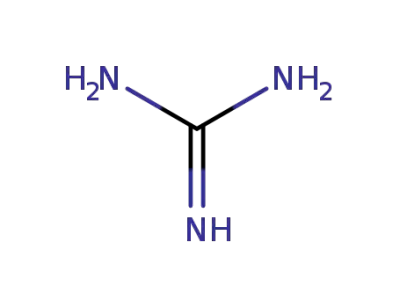
guanidine in isopropanol is added to a solution of 11.7 g (0.05 mol) of 2,6-
dichlorophenyl-acetic acid ethyl ester (BP 142°C to 143°C/12 mm of Hg) in
20cc of isopropanol. The reaction mixture is allowed to stand overnight and is
subsequently concentrated by evaporation. After recrystallizing the residue
from methanol/ether 2,6-dichlorophenyl-acetyl-guanidine is obtained in the
form of white grains having a MP of 225°C to 227°C.
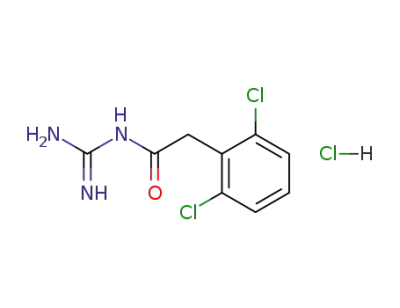
2,6-Dichlorophenyl-acetyl-guanidine hydrochloride: A solution of 5.6 g (0.025
mol) of 2,-dichlorophenylacetic acid chloride (BP 137°C to 138°C/12 mm of
Hg) in 10 cc of toluene is added dropwise to a mixture of 4.5 g (0.076 mol) of
guanidine and 60 cc of toluene. The reaction mixture is allowed to stand at
room temperature for 20 minutes, is then heated on a steam bath for 2 hours
and is subsequently cooled. The resulting precipitate is filtered off and washed
twice with 25 cc amounts of water in order to separate the guanidine
hydrochloride. The residue (2,6-dichlorophenyl-acetyl-guanidine) is washed
with chloroform for further purification and is then dissolved in 50 cc of
isopropanol. The pH-value of the solution is adjusted to 6 with ethanolic
hydrochloric acid and the solution is cooled. The resulting white needles are
again washed with chloroform. The resulting 2.6-dichlorophenyl-acetyl�guanidine hydrochloride has a MP of 213°C to 216°C. |
|
Therapeutic Function
|
Antihypertensive |
|
Synthesis
|
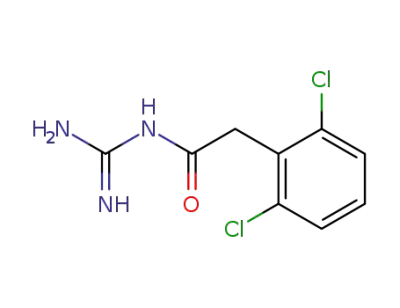
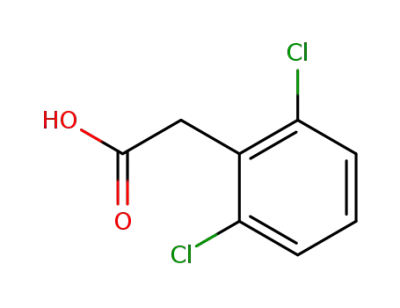
Guanfacin, N-amidino-2-(2,6-dichlorophenyl)acetamide (22.3.2), is also synthesized
in a very easy synthesis of reacting the acid chloride or ester of 2,6-
dichlorophenylacetic acid with guanidine. |
|
Brand name
|
Tenex (Dr. Reddy’s). |
|
General Description
|
Guanfacine is more selective for 2-receptors than isclonidine. Their mechanism of action is the same as that ofclonidine. Differences between clonidine and its twoanalogs are seen in their elimination half-life values and intheir metabolism and urinary excretion patterns. The eliminationhalf-life of clonidine ranges from 20 to 25 hours,whereas that for guanfacine is about 17 hours. Guanabenzhas the shortest DOA of these three agents, with a half-lifeof about 6 hours. Clonidine and guanfacine are excretedunchanged in the urine to the extent of 60% and 50%,respectively. Very little of guanabenz is excreted unchangedin the urine. |
InChI:InChI=1/C9H9Cl2N3O.ClH/c10-6-2-1-3-7(11)5(6)4-8(15)14-9(12)13;/h1-3H,4H2,(H4,12,13,14,15);1H
29110-47-2 Relevant articles
Solid-phase synthesis of N,N′-substituted acylguanidines
Dodd, Dharmpal S.,Zhao, Yufen
, p. 1259 - 1262 (2001)
An efficient method for the solid-phase ...
The preparation method of the overall tablet sizes hydrochloride (by machine translation)
-
Paragraph 0027; 0028; 0029, (2017/08/29)
The invention discloses a method for pre...
Substituted phenylacetylguanidines: a new class of antihypertensive agents
Bream,Lauener,Picard,Scholtysik,White
, p. 1477 - 1482 (2007/10/05)
The synthesis of a new series of phenyla...
29110-47-2 Process route
Conditions
| Conditions |
Yield |
|
With
ammonium hydroxide;
at 45 ℃;
for 3h;
Temperature;
|
|
29110-47-2 Upstream products
-
54551-83-6
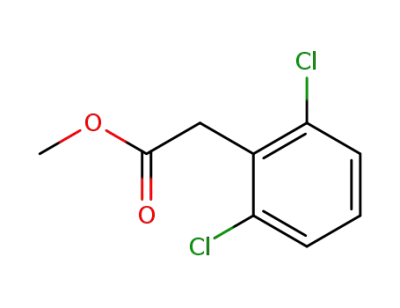
methyl 2-(2,6-dichlorophenyl)acetate
-
113-00-8
guanidine nitrate
-
6575-24-2
2-(2,6-dichlorophenyl)acetic acid
-
14527-26-5
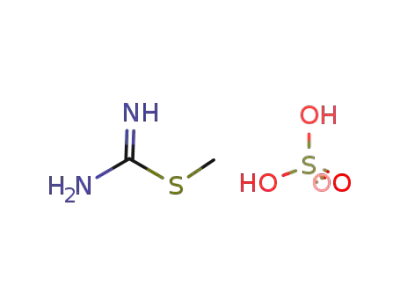
2-methylisothiourea sulphate
29110-47-2 Downstream products
-
29110-48-3
guanfacine hydrochloride