Your Location:Home >Products >Inhibitor >202821-81-6

202821-81-6

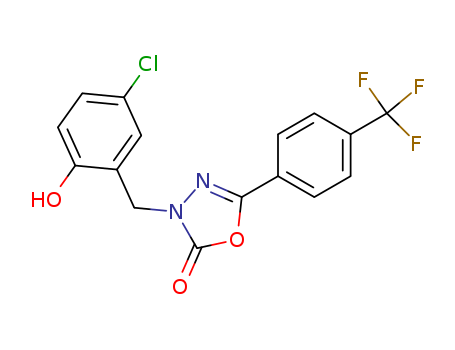
  • Product Name:BMS-191011
  • Molecular Formula:C16H10ClF3N2O3
  • Molecular Weight:370.715
Inquiry

Product Details

Purity:99%

Buy Good Quality BMS-191011 202821-81-6 with a minimum purity of 99%

  • Molecular Formula:C16H10ClF3N2O3
  • Molecular Weight:370.715
  • Vapor Pressure:0mmHg at 25°C 
  • Boiling Point:443.965oC at 760 mmHg 
  • PKA:9.27±0.43(Predicted) 
  • Flash Point:222.302oC 
  • PSA:68.26000 
  • Density:1.516g/cm3 
  • LogP:3.92940 

3-[(5-CHLORO-2-HYDROXYPHENYL)METHYL]-5-[4-(TRIFLUOROMETHYL)PHENYL]-1,3,4-OXADIAZOL-2(3H)-ONE(Cas 202821-81-6) Usage

Biological Activity

Potent Maxi-K channel opener (large-conductance Ca 2+ -activated potassium channel, K Ca 1.1, BK Ca ). Neuroprotectant in two distinct animal models of stroke (MCAO in the SHR rat and a normotensive model of focal stroke).

references

[1]. hewawasam p, ding m, chen n, et al. synthesis of water-soluble prodrugs of bms-191011: a maxi-k channel opener targeted for post-stroke neuroprotection. bioorganic & medicinal chemistry letters, 2003, 13(10): 1695-1698.[2]. valverde ma, rojas p, amigo j, et al. acute activation of maxi-k channels (hslo) by estradiol binding to the β subunit. science, 1999, 285(5435): 1929-1931.[3]. zhang y, bonnan a, bony g, et al. dendritic channelopathies contribute to neocortical and sensory hyperexcitability in fmr1-/y mice. nature neuroscience, 2014, 17(12): 1701-1709.[4]. gu xq, pamenter me, siemen d, et al. mitochondrial but not plasmalemmal bk channels are hypoxia-sensitive in human glioma. glia, 2014, 62(4): 504-513.[5]. mori a, suzuki s, sakamoto k, et al. bms-191011, an opener of large-conductance ca2+-activated potassium channels, dilates rat retinal arterioles in vivo. biological and pharmaceutical bulletin, 2011, 34(1): 150-152.[6]. romine jl, martin sw, meanwell na, et al. 3-[(5-chloro-2-hydroxyphenyl) methyl]-5-[4-(trifluoromethyl) phenyl]-1, 3, 4-oxadiazol-2 (3 h)-one, bms-191011: opener of large-conductance ca2+-activated potassium (maxi-k) channels, identification, solubility, and sar. journal of medicinal chemistry, 2007, 50(3): 528-542.

InChI:InChI=1/C16H10ClF3N2O3/c17-12-5-6-13(23)10(7-12)8-22-15(24)25-14(21-22)9-1-3-11(4-2-9)16(18,19)20/h1-7,23H,8H2

202821-81-6 Relevant articles

A BMS - 191011 synthetic method

-

Paragraph 0057; 0058; 0061; 0062, (2017/08/23)

The invention relates to a synthetic met...

Palladium-catalyzed oxidative O-H/N-H carbonylation of hydrazides: Access to substituted 1,3,4-oxadiazole-2(3 H)-ones

Ji, Fanghua,Li, Xianwei,Guo, Wei,Wu, Wanqing,Jiang, Huanfeng

, p. 5713 - 5718 (2015/06/16)

A novel palladium-catalyzed oxidative an...

3-[(5-Chloro-2-hydroxyphenyl)methyl]-5-[4-(trifluoromethyl)phenyl]-1,3, 4-oxadiazol-2(3H)-one, BMS-191011: Opener of large-conductance Ca 2+-activated potassium (maxi-K) channels, identification, solubility, and SAR

Romine, Jeffrey L.,Martin, Scott W.,Meanwell, Nicholas A.,Gribkoff, Valentin K.,Boissard, Christopher G.,Dworetzky, Steven I.,Natale, Joanne,Moon, Sandra,Ortiz, Astrid,Yeleswaram, Swamy,Pajor, Lorraine,Gao, Qi,Starrett Jr., John E.

, p. 528 - 542 (2007/10/03)

Compound 8a (BMS-191011), an opener of t...

PHOSPHATE DERIVATIVES OF DIARYL 1,3,4-OXADIAZOLONE

-

, (2008/06/13)

The present invention provides novel pho...

202821-81-6 Process route

3-[(5-Chloro-2-methoxyphenyl)methyl]-5-[4-(trifluoromethyl)-phenyl]-1,3,4-oxadiazol-2(3H)-one
202822-68-2

3-[(5-Chloro-2-methoxyphenyl)methyl]-5-[4-(trifluoromethyl)-phenyl]-1,3,4-oxadiazol-2(3H)-one

3-[(5-Chloro-2-hydroxyphenyl)methyl]-5-[4-(trifluoromethyl)-phenyl]-1,3,4-oxadiazol-2(3H)-one
202821-81-6

3-[(5-Chloro-2-hydroxyphenyl)methyl]-5-[4-(trifluoromethyl)-phenyl]-1,3,4-oxadiazol-2(3H)-one

Conditions
Conditions Yield
With methyl bromide; In dichloromethane; at 0 - 20 ℃; for 18h; Inert atmosphere;
90%
With pyridine hydrochloride; for 1h; Heating;
86%
With hydrogenchloride; pyridine hydrochloride;
With pyridine hydrochloride;
4-(trifluoromethyl)benzoic acid hydrazide
339-59-3

4-(trifluoromethyl)benzoic acid hydrazide

3-[(5-Chloro-2-hydroxyphenyl)methyl]-5-[4-(trifluoromethyl)-phenyl]-1,3,4-oxadiazol-2(3H)-one
202821-81-6

3-[(5-Chloro-2-hydroxyphenyl)methyl]-5-[4-(trifluoromethyl)-phenyl]-1,3,4-oxadiazol-2(3H)-one

Conditions
Conditions Yield
Multi-step reaction with 3 steps
1: 89 percent / Et3N / tetrahydrofuran / 18 h / 24 °C
2: 92 percent / NaH / dimethylformamide / 18 h / 60 °C
3: 86 percent / pyridine hydrochloride / 1 h / Heating
With pyridine hydrochloride; sodium hydride; triethylamine; In tetrahydrofuran; N,N-dimethyl-formamide;
Multi-step reaction with 3 steps
1: palladium(II) trifluoroacetate; trifluoroacetic acid / acetonitrile / 12 h / 60 °C
2: sodium hydride / N,N-dimethyl-formamide; mineral oil / 18 h / 60 °C / Inert atmosphere
3: methyl bromide / dichloromethane / 18 h / 0 - 20 °C / Inert atmosphere
With methyl bromide; palladium(II) trifluoroacetate; sodium hydride; trifluoroacetic acid; In dichloromethane; N,N-dimethyl-formamide; acetonitrile; mineral oil;
Multi-step reaction with 3 steps
1: palladium(II) trifluoroacetate; trifluoroacetic acid / acetonitrile / 12 h / 60 °C
2: sodium hydride / N,N-dimethyl-formamide; mineral oil / 18 h / 60 °C / Inert atmosphere
3: methyl bromide / dichloromethane / 18 h / 0 - 20 °C / Inert atmosphere
With methyl bromide; palladium(II) trifluoroacetate; sodium hydride; trifluoroacetic acid; In dichloromethane; N,N-dimethyl-formamide; acetonitrile; mineral oil;
Multi-step reaction with 3 steps
1: palladium(II) trifluoroacetate; trifluoroacetic acid / acetonitrile / 12 h / 60 °C
2: sodium hydride / N,N-dimethyl-formamide; mineral oil / 2 h / 0 °C / Inert atmosphere
3: methyl bromide / dichloromethane / 18 h / 0 - 20 °C / Inert atmosphere
With methyl bromide; palladium(II) trifluoroacetate; sodium hydride; trifluoroacetic acid; In dichloromethane; N,N-dimethyl-formamide; acetonitrile; mineral oil;
Multi-step reaction with 3 steps
1: palladium(II) trifluoroacetate; trifluoroacetic acid / acetonitrile / 12 h / 60 °C
2: triphenylphosphine; diethylazodicarboxylate / tetrahydrofuran / 24 h / 0 °C / Inert atmosphere
3: methyl bromide / dichloromethane / 18 h / 0 - 20 °C / Inert atmosphere
With methyl bromide; palladium(II) trifluoroacetate; triphenylphosphine; trifluoroacetic acid; diethylazodicarboxylate; In tetrahydrofuran; dichloromethane; acetonitrile; 2: |Mitsunobu Displacement;

202821-81-6 Upstream products

  • 202822-68-2
    202822-68-2

    3-[(5-Chloro-2-methoxyphenyl)methyl]-5-[4-(trifluoromethyl)-phenyl]-1,3,4-oxadiazol-2(3H)-one

  • 339-59-3
    339-59-3

    4-(trifluoromethyl)benzoic acid hydrazide

  • 455-24-3
    455-24-3

    4-trifluoromethylbenzoic acid

  • 202823-22-1
    202823-22-1

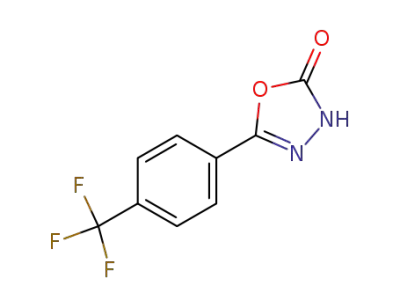
    5-[4-(trifluoromethyl)phenyl]-1,3,4-oxadiazol-2-(3H)-one

202821-81-6 Downstream products

  • 234433-31-9
    234433-31-9

    4-Chloro-2-[[5-[4-(trifluoromethyl)phenyl]-2,3-dihydro-2-oxo-1,3,4-oxadiazol-3-yl]methyl]phenyl chloroformate

  • 233676-37-4
    233676-37-4

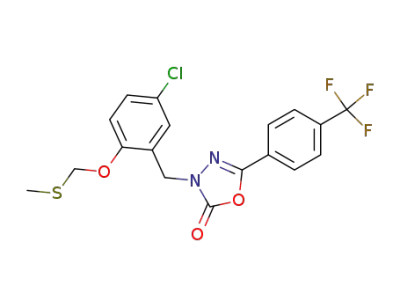
    3-[(5-chloro-2-[(methylthiomethyl)oxy]-phenyl)methyl]-5-[4-(trifluoromethyl)phenyl]-1,3,4-oxadiazol-2(3H)-one

  • 233676-36-3
    233676-36-3

    3-[(5-Chloro-2-[[bis[phenylmethyl]phosphono]oxy]phenyl)-methyl]-5-[4-(trifluoromethyl)phenyl]-1,3,4-oxadiazol-2(3H)-one

  • 233676-40-9
    233676-40-9

    3-[(5-Chloro-2-[[(chloromethyl)oxy]carbonyloxy]phenyl)methyl]-5-[4-(trifluoromethyl)phenyl]-1,3,4-oxadiazol-2(3 H)-one