Factory Supply Industrial Grade Moclobemide 71320-77-9 with Best Price
- Molecular Formula:C13H17ClN2O2
- Molecular Weight:268.743
- Appearance/Colour:White to off-white solid
- Vapor Pressure:3.29E-08mmHg at 25°C
- Melting Point:137 °C
- Refractive Index:1.55
- Boiling Point:447.7 °C at 760 mmHg
- PKA:14.26±0.46(Predicted)
- Flash Point:224.6 °C
- PSA:41.57000
- Density:1.206 g/cm3
- LogP:1.73080
Moclobemide(Cas 71320-77-9) Usage
|
Biochem/physiol Actions
|
Moclobemide is a reversible monoamine oxidase A inhibitor (MAOI); antidepressant. Elimination half-life in humans = 1 -3 hrs; absolute oral bioavailability. Unlike other MAO inhibitors, does not significantly increase blood pressure in humans upon combination with tyramine. |
|
Mechanism of action
|
Moclobemide is an RIMA that preferentially inhibits MAO-A (~80%) and, to a lesser extent, MAO-B (20–30%
inhibition), thereby increasing the concentration of 5-HT, NE, and other catecholamines in the synaptic cleft
and in storage sites. During chronic therapy with the MAOIs, adaptive changes at the noradrenergic and
serotonergic receptors occur (“downregulation”) as a result of neurotransmitter hypersensitivity because of
prolonged concentrations of NE and 5-HT at the postsynaptic receptor. This mechanism is likely the basis for its antidepressant activity. Inhibition
of MAO-A by moclobemide is short-acting (maximum, 24 hours) and reversible. This is in contrast to
phenelzine, which is nonselective, long-acting, and irreversible in its binding to MAO-A and MAO-B.
The pharmacokinetics for moclobemide are linear only up to 200 mg; at higher doses, nonlinear
pharmacokinetics are observed. Although well absorbed from the GI tract, the presence of food reduces
the rate but not the extent of absorption of moclobemide. Small quantities of moclobemide are distributed into
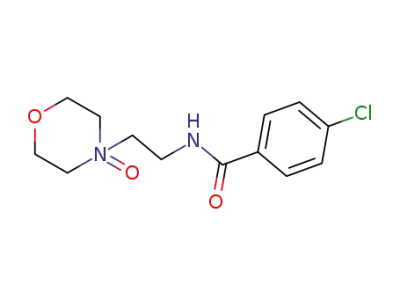
human breast milk. Moclobemide undergoes a complex metabolism, initially involving morpholine carbon and
nitrogen oxidation, deamination, and aromatic hydroxylation. The N-oxide and ring-opened metabolites retain
some in vitro MAO-A inhibition. Moclobemide is a weak inhibitor of CYP2D6 in vitro. It is extensively
metabolized in the liver by oxidation and is eliminated primarily into the urine as conjugates. Less than 1% of
an administered dose of moclobemide is eliminated unmetabolized.
Because moclobemide is partially metabolized by the polymorphic isozymes CYP2C19 and CYP2D6, plasma
concentrations of moclobenmide may be affected in patients who are poor metabolizers. In patients who are
slow metabolizers, the AUC for moclobemide was 1.5 times greater than the AUC in patients who are extensive metabolizers and receiving the same dose. This increase is within the normal range of variation (up to twofold) typically seen in patients. |
|
Drug interactions
|
Drug interactions for the RIMAs include interaction with SSRI antidepressants, which can cause the 5-HT
syndrome. The effect of stimulant drugs, such as methylphenidate and
dextroamphetamine (used to treat ADHD), may be increased. Some over-the-counter cold and hay fever
decongestants (i.e., sympathomimetic amines) can have increased stimulant effects. Selegiline, a selective
MAO-B used for Parkinson's disease, should not be used concurrently with the RIMAs. Unlike the irreversible
MAOIs, no significant interactions with foods occur, because the selective inhibition of MAO-A does not stop
the metabolism of tyramine. The RIMAs must not be taken concurrently with a nonreversible MAOI. |
|
Metabolism
|
Moclobemide is extensively metabolised in the liver, partly
by the cytochrome P450 isoenzymes CYP2C19 and
CYP2D6.
Metabolites of moclobemide and a small amount of
unchanged drug are excreted in the urine |
|
references
|
[1] pisani l, barletta m, soto-otero r, nicolotti o, mendez-alvarez e, catto m, introcaso a, stefanachi a, cellamare s, altomare c, carotti a. discovery, biological evaluation, and structure-activity and -selectivity relationships of 6'-substituted (e)-2-(benzofuran-3(2h)-ylidene)-n-methylacetamides, a novel class of potent and selective monoamine oxidase inhibitors. j med chem. 2013 mar 28;56(6):2651-64. [2] nair np, ahmed sk, kin nm. biochemistry and pharmacology of reversible inhibitors of mao-a agents: focus on moclobemide. j psychiatry neurosci. 1993 nov;18(5):214-25. |
|
Definition
|
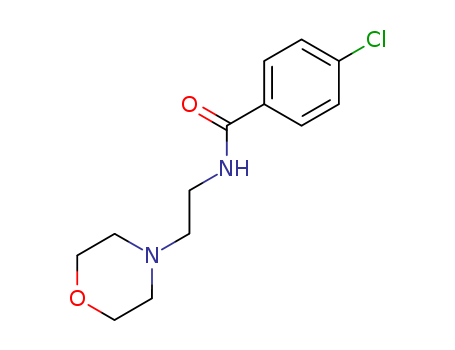
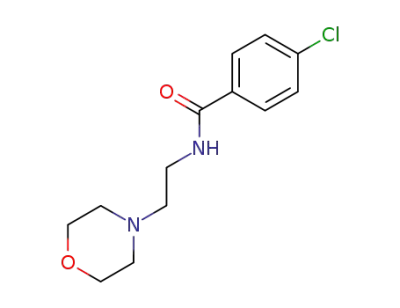
ChEBI: A member of the class of benzamides that is benzamide substituted by a chloro group at position 4 and a 2-(morpholin-4-yl)ethyl group at the nitrogen atom. It acts as a reversible monoamine oxidase inhibitor and is used in the treatment of depression. |
|
Brand name
|
Aurorix |
InChI:InChI=1/C13H17ClN2O2/c14-12-3-1-11(2-4-12)13(17)15-5-6-16-7-9-18-10-8-16/h1-4H,5-10H2,(H,15,17)
71320-77-9 Relevant articles
Biocatalytic Synthesis of Moclobemide Using the Amide Bond Synthetase McbA Coupled with an ATP Recycling System
Fairlamb, Ian J. S.,Grogan, Gideon,Lloyd, Richard C.,Petchey, Mark R.,Rowlinson, Benjamin
, p. 4659 - 4663 (2020)
The biocatalytic synthesis of amides fro...
Reaction-based two-photon probes for in vitro analysis and cellular imaging of monoamine oxidase activity
Kim, Dokyoung,Sambasivan, Sunderraman,Nam, Hyoseok,Ki, Hean Kim,Jin, Yong Kim,Joo, Taiha,Lee, Kyung-Ha,Kim, Kyong-Tai,Han Ahn, Kyo
, p. 6833 - 6835 (2012)
Reaction-based fluorescent probes for mo...
Amide Bond Formation via the Rearrangement of Nitrile Imines Derived from N-2-Nitrophenyl Hydrazonyl Bromides
Boyle, Mhairi,Livingstone, Keith,Henry, Martyn C.,Elwood, Jessica M. L.,Lopez-Fernandez, J. Daniel,Jamieson, Craig
supporting information, p. 334 - 338 (2022/01/20)
We report how the rearrangement of highl...
Water-removable ynamide coupling reagent for racemization-free syntheses of peptides, amides, and esters
Liu, Tao,Zhang, Xue,Peng, Zejun,Zhao, Junfeng
supporting information, p. 9916 - 9921 (2021/12/24)
A novel ynamide coupling reagent, the by...
Near-Ambient-Temperature Dehydrogenative Synthesis of the Amide Bond: Mechanistic Insight and Applications
Kar, Sayan,Xie, Yinjun,Zhou, Quan Quan,Diskin-Posner, Yael,Ben-David, Yehoshoa,Milstein, David
, p. 7383 - 7393 (2021/06/30)
The current existing methods for the ami...
Photocatalytic synthesis method of N-(2-morpholinoethyl) substituted benzamide compound
-
Paragraph 0035-0042; 0065-0071, (2021/11/26)
The invention relates to a photocatalyti...
71320-77-9 Process route
-
-
2038-03-1
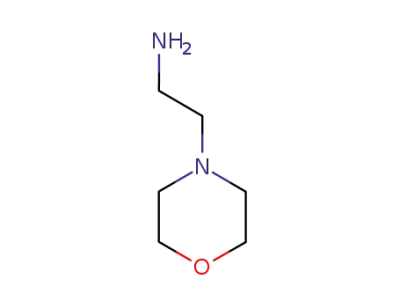
4-(2-AMINOETHYL)MORPHOLINE
-
-
6264-29-5
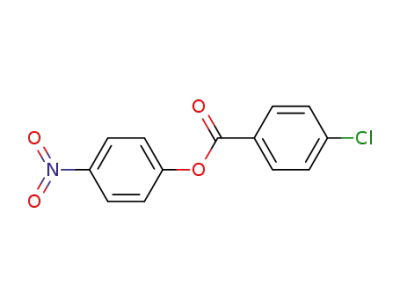
4-nitrophenyl 4-chlorobenzoate
Conditions
| Conditions |
Yield |
|
4-nitrophenyl 4-chlorobenzoate;
With
1,3-dimethylimidazolim iodide; 1,8-diazabicyclo[5.4.0]undec-7-ene;
In
tetrahydrofuran;
for 0.333333h;
Schlenk technique;
4-(2-AMINOETHYL)MORPHOLINE;
In
tetrahydrofuran;
at 20 ℃;
for 0.5h;
|
85%
|
|
With
sodium hydroxide;
In
tetrahydrofuran; dichloromethane; water;
|
|
-
-
2038-03-1
4-(2-AMINOETHYL)MORPHOLINE
-
-
122-01-0
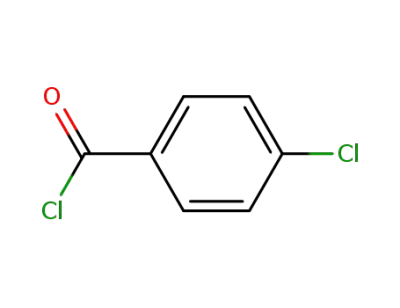
4-chloro-benzoyl chloride
Conditions
| Conditions |
Yield |
|
With
triethylamine;
at 0 - 20 ℃;
for 13h;
|
95%
|
|
With
pyridine;
|
71%
|
|
With
triethylamine;
In
dichloromethane;
at 20 ℃;
for 17h;
Inert atmosphere;
|
41%
|
|
With
triethylamine;
In
dichloromethane;
at 0 - 20 ℃;
for 12h;
|
35%
|
|
In
pyridine; ice-water; dichloromethane; toluene;
|
|
|
for 3h;
|
207 mg
|
|
at 0 - 20 ℃;
for 20h;
Alkaline conditions;
|
|
71320-77-9 Upstream products
71320-77-9 Downstream products