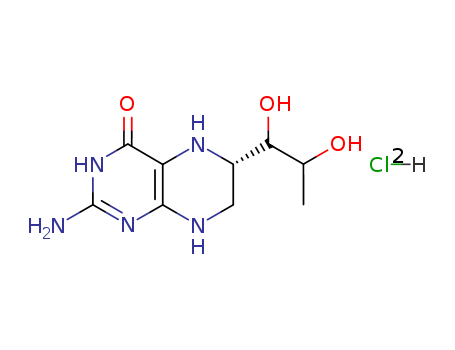
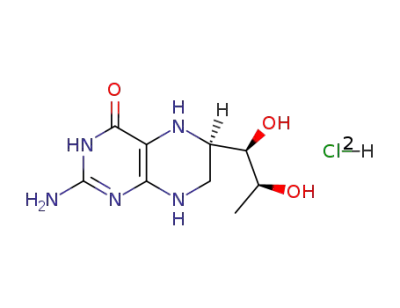
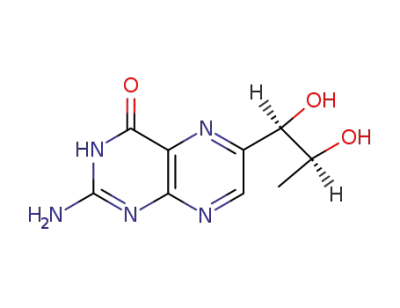
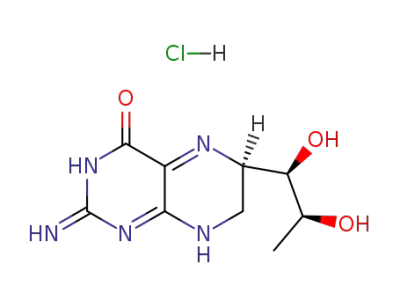
Factory Supply industrial standard Sapropterin Hydrochloride 69056-38-8 In Stock
- Molecular Formula:C9H15N5O3*2ClH
- Molecular Weight:314.172
- Appearance/Colour:white crystalline solid
- Vapor Pressure:2.2E-12mmHg at 25°C
- Melting Point:245-246° (dec)
- Boiling Point:506.6 °C at 760 mmHg
- Flash Point:260.2 °C
- PSA:136.29000
- LogP:0.76100
(6R)-5,6,7,8-TETRAHYDRO-L-BIOPTERIN DIHYDROCHLORIDE(Cas 69056-38-8) Usage
|
Biochem/physiol Actions
|
Lack of tetrahydrobiopterin may cause hyperphenylalaninemia. Diseases like, Parkinson′s, autism, depression and Alzheimer′s shows low concentration of tetrahydrobiopterin in the cerebrospinal fluid. This coenzyme participates in dopamine (DA) synthesis. |
|
Purification Methods
|
Recrystallisation of BH4.2HCl from HCl enriches BH4 in the natural 6R isomer. Dissolve the salt (~6g) in conc HCl (15mL) under gentle warming, then add EtOH (30mL) dropwise, chill and collect the colourless needles (67%, up to 99% if the mother liquors are concentrated), and dry it in vacuo immediately over P2O5 and KOH. It is stable indefinitely at -20o in a dry atmosphere. Better store it in sealed ampoules under dry N2. It can be recrystallised from 6N aqueous HCl. It has UV max (in 2N HCl) at 264nm (� 16,770; pH 3.5 phosphate buffer) 265nm (� 13,900); (in pH 7.6) at 297nm (� 9,500) and 260nm sh (� 4,690). It has been separated from the 6S-isomer by HPLC on a Partisil-10SCX column using 30mM ammonium phosphate buffer (pH 3.0) containing 3mM NaHSO3 (2mL/minute flow rate; 275nm detector) with retention times of 5.87minutes (6R) and 8.45minutes (6S). It is stable in acidic solutions and can be stored for extended periods at -20o in 0.04M HCl. Above pH 7 the neutral species are obtained, and these are readily oxidised by the oxygen in the solvent to the quinonoid species, and then further oxidation and degradation occurs at room temperature. These changes are slower at 0o. The sulfate salt can be obtained by recrystallisation from 2M H2SO4 and is less soluble in water than the hydrochloride salt. The 6R-2,5,1',2'-tetraacetylbiopterin derivative has m 292o(dec) after recrystallisation from MeOH (100 parts) and [] 20 -144o (c 0.5, CHCl3), [] 589 +12.8o (c 0.39, Me2SO). [NMR, UV: Matsuura et al. Heterocycles 23 3115 1985, Viscontini et al. Helv Chim Acta 62 2577 1979, Armarego et al. Aust J Chem 37 355 1984, Beilstein 26 III/IV 4032.] |
|
Definition
|
ChEBI: The dihydrochloride salt of sapropterin. It is used for the diagnosis and treatment of variant forms of phenylketonuria (hyperphenylalaninaemia) associated with tetrahydrobiopterin deficiency. Natural cofactor for phenylalanine hydroxylase, tyrosine hydrox
lase, tryptophan hydroxylase, and nitric oxide synthetase. |
|
Brand name
|
Biopten |
|
General Description
|
Tetrahydrobiopterin is a natural cofactor for phenylalanine hydroxylase, tyrosine hydroxylase, tryptophan hydroxylase, nitric oxide synthase and alkylglycerol monooxygenase. |
InChI:InChI=1/C9H15N5O3.2ClH/c1-3(15)6(16)4-2-11-7-5(12-4)8(17)14-9(10)13-7;;/h3-4,6,12,15-16H,2H2,1H3,(H4,10,11,13,14,17);2*1H/t3-,4?,6?;;/m0../s1
69056-38-8 Relevant articles
Chemical synthesis and purification method of biopterin (by machine translation)
-
Paragraph 0013-0016, (2020/03/17)
The method, uses diacetyl biopterin as a...
METHOD FOR SYNTHESIZING SAPROPTERIN DIHYDROCHLORIDE
-
Paragraph 0041, (2015/03/03)
Disclosed is a method for synthesizing s...
METHOD FOR SYNTHESIZING SAPROPTERIN DIHYDROCHLORIDE
-
Paragraph 0064, (2015/05/05)
Disclosed is a method for synthesizing s...
METHOD FOR SYNTHESIZING SAPROPTERIN DIHYDROCHLORIDE
-
Paragraph 0031, (2015/03/03)
Disclosed is a method for synthesizing s...
69056-38-8 Process route
-
-
69056-38-8,69056-39-9,71074-53-8,83023-72-7,83709-59-5,90366-07-7
Sapropterin dihydrochloride
Conditions
| Conditions |
Yield |
|
C11H15N5O4;
With
palladium on carbon; hydrogen;
In
water;
at 20 ℃;
for 80h;
under 4500.45 Torr;
Large scale;
With
hydrogenchloride;
In
water;
Reagent/catalyst;
Solvent;
Temperature;
Large scale;
|
50%
|
|
C11H15N5O4;
With
palladium on carbon; hydrogen;
In
water;
at 20 ℃;
for 80h;
under 4500.45 Torr;
Large scale;
With
hydrogenchloride;
In
water;
Reagent/catalyst;
Solvent;
Pressure;
Temperature;
Large scale;
|
50%
|
|
With
palladium on carbon; hydrogen;
In
water;
at 20 ℃;
for 80h;
under 4500.45 Torr;
Concentration;
Reagent/catalyst;
Pressure;
Temperature;
Solvent;
Large scale;
|
0.95 kg
|
|
With
palladium on carbon; hydrogen;
In
water;
at 15 - 25 ℃;
for 80h;
under 4125.41 - 4875.49 Torr;
Reagent/catalyst;
Large scale;
|
|
-
-
69056-38-8,69056-39-9,71074-53-8,83023-72-7,83709-59-5,90366-07-7
Sapropterin dihydrochloride
Conditions
| Conditions |
Yield |
|
With
hydrogenchloride; platinum(IV) oxide; tetramethyl ammoniumhydroxide; water;
at 25 ℃;
for 8h;
under 9000.9 Torr;
pH=Ca. 11.5;
Reagent/catalyst;
Pressure;
Inert atmosphere;
|
|
69056-38-8 Upstream products
69056-38-8 Downstream products
-
102340-67-0
p-quinonoid (6R)-dihydrobiopterin hydrochloride
-
1041007-05-9
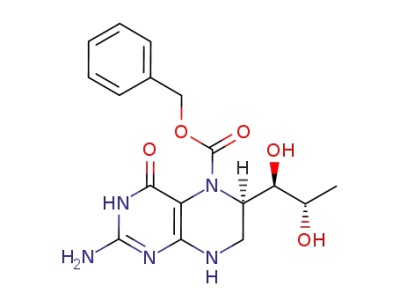
(R)-2-amino-6-((1R,2S)-1,2-dihydroxypropyl)-4-oxo-4,6,7,8-tetrahydro-3H-pteridine-5-carboxylic acid benzyl ester