Purity 99% Min TOLBUTAMIDE 64-77-7 Spot Supply with Safe Transportation
- Molecular Formula:C12H18N2O3S
- Molecular Weight:270.353
- Appearance/Colour:white crystalline powder
- Melting Point:128-130°C
- Refractive Index:1.6360 (estimate)
- Boiling Point:white crystalline powder
- PKA:pKa 5.32(H2O
t = 37) (Uncertain)
- PSA:83.65000
- Density:1.184 g/cm3
- LogP:3.64560
TOLBUTAMIDE(Cas 64-77-7) Usage
|
Manufacturing Process
|
50 grams of n-butyl isocyanate are stirred at room temperature into a
suspension of 96 grams of sodium 4-methyl-benzenesulfonamide in 120 cc of
dry nitrobenzene and the whole is then heated for 7 hours at 100°C. After
being cooled, the reaction mixture, which is a thick magma, is diluted with
methylene chloride or ethyl acetate and the sodium salt of the sulfonylurea
formed is separated by centrifuging. The centrifuged crystalline residue freed
from organic solvents is dissolved in 500 to 600 cc of water heated at 50°C
and decolorized with animal charcoal.
The precipitate obtained by acidification with dilute hydrochloric acid is
dissolved in an equivalent quantity of dilute ammonia solution (about 1:20),
again treated with animal charcoal and reprecipitated with dilute hydrochloric
acid. In this manner N-4-methylbenzenesulfonyl-N'-n-butyl-urea is obtained in
analytically pure form in a yield of 70 to 80% of theory. It melts at 125° to
127°C (with decomposition). |
|
Therapeutic Function
|
Oral hypoglycemic |
|
Air & Water Reactions
|
Insoluble in water. |
|
Reactivity Profile
|
TOLBUTAMIDE is an amide. Amides/imides react with azo and diazo compounds to generate toxic gases. Flammable gases are formed by the reaction of organic amides/imides with strong reducing agents. Amides are very weak bases (weaker than water). Imides are less basic yet and in fact react with strong bases to form salts. That is, they can react as acids. Mixing amides with dehydrating agents such as P2O5 or SOCl2 generates the corresponding nitrile. The combustion of these compounds generates mixed oxides of nitrogen (NOx). TOLBUTAMIDE is incompatible with acids. . |
|
Fire Hazard
|
Flash point data for TOLBUTAMIDE are not available. TOLBUTAMIDE is probably combustible. |
|
Biological Activity
|
tolbutamide is a potent inhibitor of camp with an ic50 value of 4mm [1].tolbutamide has been reported to inhibit both the basal and the cyclic amp-stimulated protein kinase activites with an ic50 value of 4mm for cyclic amp-dependent kinase activity. in addition, tolbutamide has been revealed to inhibit both soluble and membrane-bound protein kinase from canine heart. moreover, the tolbutamide inhibition of adipose tissue cyclic amp- dependent protein kinase is explanation for antilipolytic effects [1]. besides, tolbutamide and dbcamp has been exhibited to increase about four-fold levels of cx43 mrna and decrease about 80% the expression of ki-67 [2]. |
|
Mechanism of action
|
Tolbutamide is one of the most widely used antidiabetic agents. Its action is preferably
connected with stimulatory action of β-cells in the pancreas, which results in intensive
insulin secretion. |
|
Safety Profile
|
Moderately toxic by
ingestion and several other routes. A human
teratogen. Human reproductive effects by
ingestion and possibly other routes:
stillbirth, developmental abnormalities of
the cardlovascular (circulatory) system and
urogenital system, and unspecified neonatal
effects. Human systemic effects by
ingestion: nausea or vomiting, hypoglycemia.
Other experimental teratogenic and
reproductive effects. Mutation data
reported. Implicated in aplastic anemia.
When heated to decomposition it emits very
toxic fumes of NO, and SOx. |
|
Synthesis
|
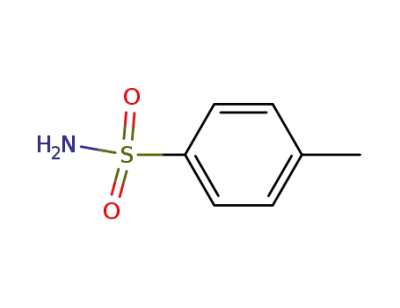
Tolbutamide, 1-butyl-3-p-toluenesulfonylurea (26.2.2), is made in a single step
reaction by interaction of p-toluenesulfonylamide (in the form of sodium salt) with butylisocyanate. |
|
Drug interactions
|
Potentially hazardous interactions with other drugs
Analgesics: effects enhanced by NSAIDs - avoid
with azapropazone.
Antibacterials: effects enhanced by chloramphenicol,
sulphonamides, tetracyclines and trimethoprim;
effect reduced by rifamycins.
Anticoagulants: effect possibly enhanced by
coumarins; also possibly changes to INR.
Antifungals: concentration increased by fluconazole
and miconazole, and possibly voriconazole.
Lipid-regulating drugs: possibly additive
hypoglycaemic effect with fibrates.
Sulfinpyrazone: enhanced effect of sulphonylureas. |
|
Metabolism
|
Tolbutamide is metabolised in the liver by hydroxylation mediated by the cytochrome P450 isoenzyme CYP2C9. It is excreted in the urine chiefly as inactive metabolites. |
|
references
|
[1] wray hl, harris aw. adenosine 3', 5'-monophosphate-dependent protein kinase in adipose tissue: inhibition by tolbutamide. biochem biophys res commun. 1973 jul 2;53(1):291-4.[2] sánchez-alvarez r1, paíno t, herrero-gonzález s, medina jm, tabernero a. tolbutamide reduces glioma cell proliferation by increasing connexin43, which promotes the up-regulation of p21 and p27 and subsequent changes in retinoblastoma phosphorylation. glia. 2006 aug 1;54(2):125-34. |
|
Definition
|
ChEBI: An N-sulfonylurea that consists of 1-butylurea having a tosyl group attached at the 3-position. |
|
General Description
|
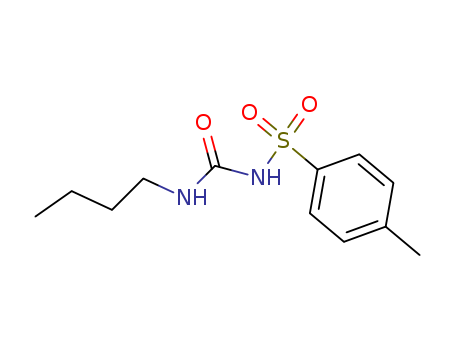
Tolbutamide is N-[(butylamino)carbonyl]-4-methylbenzenesulfonamide;or 1-butyl-3-(p-tolylsulfonyl)urea (Orinase,generic). Orinase Diagnostic was the sodium salt, which isfreely soluble in water for injection, but this product was discontinuedc. 2000. |
InChI:InChI=1/C12H18N2O3S/c1-3-4-9-13-12(15)14-18(16,17)11-7-5-10(2)6-8-11/h5-8H,3-4,9H2,1-2H3,(H2,13,14,15)
64-77-7 Relevant articles
Rapid Multigram-Scale End-to-End Continuous-Flow Synthesis of Sulfonylurea Antidiabetes Drugs: Gliclazide, Chlorpropamide, and Tolbutamide
Sagandira, Cloudius R.,Watts, Paul
supporting information, (2021/12/02)
A multigram-scale robust, efficient, and...
A facile synthesis of sulfonylureas: Via water assisted preparation of carbamates
Tanwar, Dinesh Kumar,Ratan, Anjali,Gill, Manjinder Singh
, p. 4992 - 4999 (2017/07/11)
A novel and simple approach to the synth...
Product-Derived Bimetallic Palladium Complex Catalyzes Direct Carbonylation of Sulfonylazides
Zhao, Jin,Li, Zongyang,Song, Shaole,Wang, Ming-An,Fu, Bin,Zhang, Zhenhua
supporting information, p. 5545 - 5549 (2016/05/09)
A novel product-derived bimetallic palla...
Mechanosynthesis of pharmaceutically relevant sulfonyl-(thio)ureas
Tan, Davin,?trukil, Vjekoslav,Mottillo, Cristina,Fri??i?, Tomislav
supporting information, p. 5248 - 5250 (2014/05/06)
We demonstrate the first application of ...
64-77-7 Process route
-
-
3898-47-3
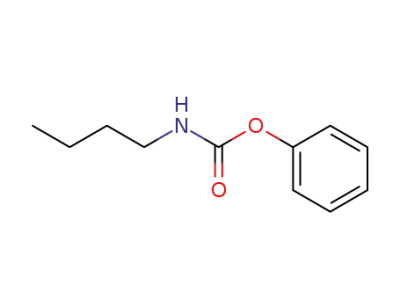
phenyl-N-butylcarbamate
-
-
70-55-3
toluene-4-sulfonamide
-
-
64-77-7
N-[(butylamino)carbonyl]-4-methyl-benzenesulfonamide
Conditions
| Conditions |
Yield |
|
With
1,8-diazabicyclo[5.4.0]undec-7-ene;
In
chloroform; acetonitrile;
at 80 ℃;
for 8h;
Flow reactor;
Large scale;
|
97%
|
|
With
1,8-diazabicyclo[5.4.0]undec-7-ene;
In
acetonitrile;
Reflux;
Green chemistry;
|
80%
|
-
-
70-55-3
toluene-4-sulfonamide
-
-
109-73-9,85404-21-3
N-butylamine
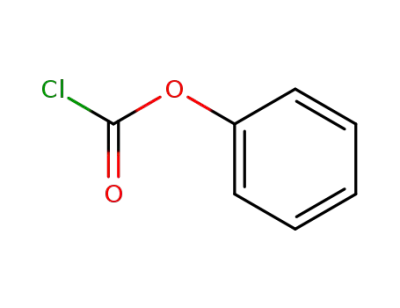
-
-
1885-14-9
phenyl chloroformate
-
-
64-77-7
N-[(butylamino)carbonyl]-4-methyl-benzenesulfonamide
Conditions
| Conditions |
Yield |
|
N-butylamine; phenyl chloroformate;
With
tributyl-amine;
In
chloroform;
at 0 ℃;
for 0.00833333h;
Flow reactor;
Large scale;
toluene-4-sulfonamide;
With
1,8-diazabicyclo[5.4.0]undec-7-ene;
In
chloroform; acetonitrile;
at 80 ℃;
for 8h;
Reagent/catalyst;
Flow reactor;
Large scale;
|
94%
|
64-77-7 Upstream products
-
41891-17-2
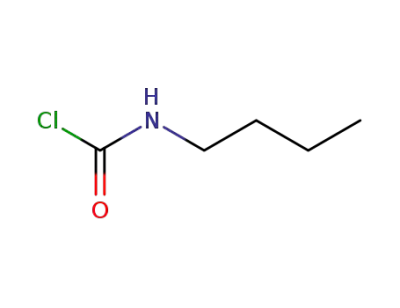
N-butylcarbamoyl chloride
-
18522-92-4
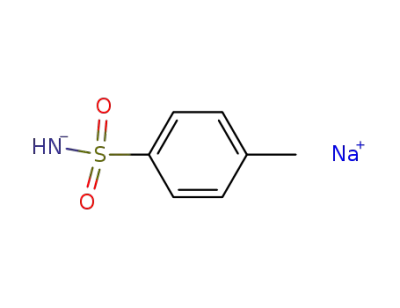
sodium p-toluenesulfonamide
-
4932-55-2
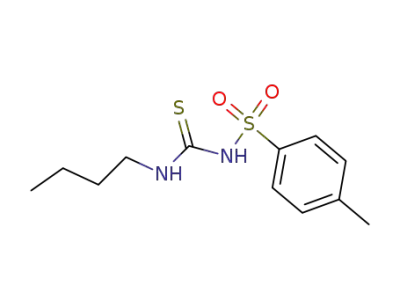
N-(4-methylphenylsulfonyl)-N'-butylthiourea
-
98275-71-9
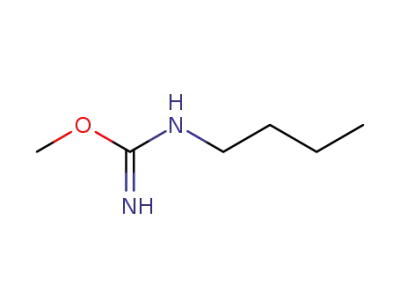
N-butyl-O-methyl-isourea
64-77-7 Downstream products



![N-[(butylamino)carbonyl]-4-methyl-benzenesulfonamide](/upload/2026/5/7e4bc2bc-f9da-41f3-b8f4-122a3660641e.png)