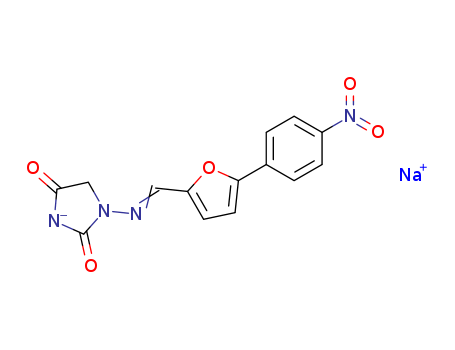
Quality Manufacturer Supply High Purity 99% Dantrolene Sodium Hemiheptahydrate 24868-20-0 with Reasonable Price
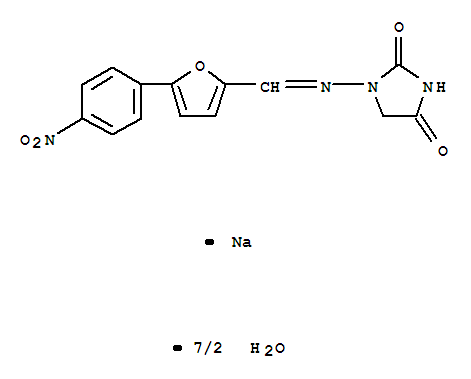
- Molecular Formula:C14H9N4NaO5.7/2H2O
- Molecular Weight:336.23
- Appearance/Colour:Orange powder
- Vapor Pressure:1.09E-12mmHg at 25°C
- Melting Point:>230°C
- Boiling Point:544.5°C at 760 mmHg
- Flash Point:283.1°C
- PSA:318.71000
- LogP:2.97810
Dantrolene sodium(Cas 24868-20-0) Usage
|
Manufacturing Process
|
5-(p-Nitrophenyl)-2-furaldehyde (40.0 grams, 0.2 mol) is dissolved in
dimethylformamide. An aqueous solution of 1-aminohydantoin hydrochloride
(30.0 grams, 0.2 mol) is added. The solution is chilled and diluted with water.
The crude material is collected and recrystallized from aqueous
dimethylformamide to yield 10.0 grams (16%). MP 279°-280°C. This
compound is then converted to the sodium salt. |
|
Therapeutic Function
|
Muscle relaxant |
|
Biological Functions
|
Dantrolene sodium (Dantrium) is used in the treatment
of spasticity due to stroke, spinal injury, multiple sclerosis,
or cerebral palsy. It is also the drug of choice in prophylaxis
or treatment of malignant hyperthermia.
Susceptibility to malignant hyperthermia is due to a
rare genetic defect that allows Ca++ release from the
sarcoplasmic reticulum to open more easily and close
less readily than normal. This leads to a high level of
Ca++ in the sarcoplasm, which produces muscle rigidity,
oxygen consumption, and heat. Dantrolene acts by
blocking Ca++ release from the sarcoplasmic reticulum
and uncoupling excitation from contraction.
Dantrolene is active orally, although its absorption is
slow and incomplete. Its biological half-life (t1/2) is 8.7
hours in adults. The drug is metabolized by liver microsomal
enzymes and is eliminated in the urine and bile.
It is given IV when treating an attack of malignant hyperthermia.
The most prominent and often limiting feature of
dantrolene administration is dose-dependent muscle
weakness. Other side effects are drowsiness, dizziness,
malaise, fatigue, and diarrhea. Symptomatic hepatitis is
reported in 0.5% of patients receiving it and fatal hepatitis
in up to 0.2%. Contraindications include respiratory
muscle weakness and liver disease. It is suggested
that patients on dantrolene therapy be given regular
liver function tests. |
|
Veterinary Drugs and Treatments
|
In humans, oral dantrolene is indicated primarily for the treatment
associated with upper motor neuron disorders (e.g., multiple sclerosis,
cerebral palsy, spinal cord injuries, etc.). In veterinary medicine,
its proposed indications include: the prevention and treatment of
malignant hyperthermia syndrome in various species, the treatment
of functional urethral obstruction due to increased
external urethral
tone in dogs and cats, the prevention and treatment of equine postanesthetic
myositis (PAM), and equine exertional rhabdomyolysis.
It has also been recommended for use in the treatment of bites from
Black Widow Spiders in small animals and the treatment of porcine
stress syndrome. |
|
Drug interactions
|
Potentially hazardous interactions with other drugsAvoid with other hepatotoxic medication. |
|
Metabolism
|
Dantrolene is inactivated by hepatic metabolism in the
first instance. There are two alternative pathways. Most
of the drug is hydroxylated to 5-hydroxydantrolene.
The minor pathway involves nitro-reduction to amino�dantrolene, which is then acetylated (compound F-490).
The 5-hydroxy metabolite is a muscle relaxant with nearly
the same potency as the parent molecule, and may have
a longer half-life than the parent compound. Compound
F-490 is much less potent and is probably inactive at the
concentrations achieved in clinical samples. Metabolites
are subsequently excreted in the urine in the ratio of 79
5 hydroxy-dantrolene: 17 compound F-490: 4 unaltered
dantrolene (salt or free acid). The proportion of drug
excreted in the faeces depends upon dose size. |
|
Definition
|
ChEBI: A hydrate which is the hemiheptahydrate of anhydrous dantrolene sodium. |
InChI:InChI=1/2C14H10N4O5.2Na.7H2O/c2*19-13-8-17(14(20)16-13)15-7-11-5-6-12(23-11)9-1-3-10(4-2-9)18(21)22;;;;;;;;;/h2*1-7H,8H2,(H,16,19,20);;;7*1H2/q;;2*+1;;;;;;;/p-2/b2*15-7+;;;;;;;;;